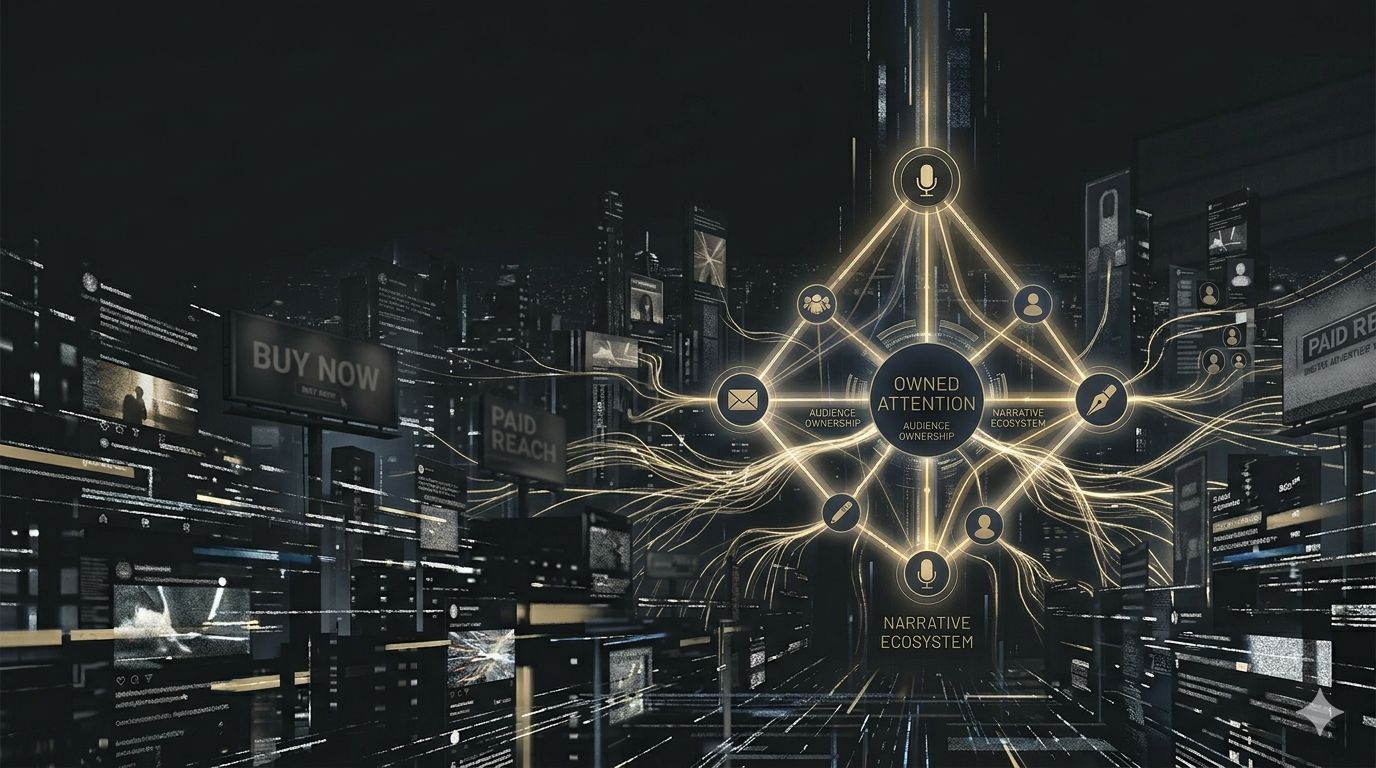
For decades, competitive advantage in marketing meant one thing: securing visibility. Brands purchased distribution television slots, print pages, search terms and expected predictable returns. Reach equaled opportunity. That assumption held because visibility itself was scarce.
That model has inverted. The digital economy no longer suffers from a lack of visibility but from an excess of it. Every platform is saturated. Every algorithm is designed to bury most content. Every consumer encounters thousands of marketing messages daily. In this environment, attention not visibility has become the constraining resource.
When visibility was scarce, controlling distribution channels mattered most. Now that distribution is fragmented and content is abundant, narrative control matters most. The companies that define how their category is discussed increasingly define who wins the category.
The evidence is structural. Meta’s 2018 algorithm change cut organic brand reach by 50% overnight. Apple’s 2021 privacy update cost Facebook $10 billion in lost ad revenue. A 60-second video loses 60% of viewers in the first five seconds. Meanwhile, spending on performance advertising continues rising while conversion efficiency declines across nearly every major platform. The math no longer works for traditional media buying.
Companies are realizing that rented distribution visibility purchased through platforms is inherently fragile. An algorithm update disrupts reach overnight. A policy change destabilizes customer acquisition. Platform dependency has become a structural business risk.
The response is a shift toward owned attention systems: direct audience relationships through email and communities, editorial platforms, founder-led branding inseparable from company narrative, content ecosystems treated as core infrastructure rather than marketing support.
This shift is visible across industries. Stripe built premium positioning in payments through institutional publications and thought leadership that shaped industry conversation. Figma dominated design tools through culture and community, not paid campaigns. OpenAI framed the entire AI narrative through product philosophy and founder visibility. Notion became the default in knowledge management through community adoption and aesthetic narrative control.
Agencies are restructuring in parallel. Traditional creative firms operated as service providers replaceable execution, volatile revenue, low durable value. Now major agencies invest in owned intellectual property, creator networks, editorial platforms, and branded communities. They recognize that owning audience attention creates more defensible long-term leverage than repeatedly renting visibility.
The economics are straightforward. A service business scales linearly. A business that owns audience attention compounds. More importantly, owned attention becomes increasingly valuable as platforms grow more crowded and algorithmic uncertainty increases.
This explains why founders are becoming creators, why SaaS companies are investing in thought leadership, why brands are launching podcasts and newsletters, why enterprises are prioritizing community. Attention is becoming infrastructure the foundational layer on which customer acquisition, brand positioning, pricing power, and investor perception depend.
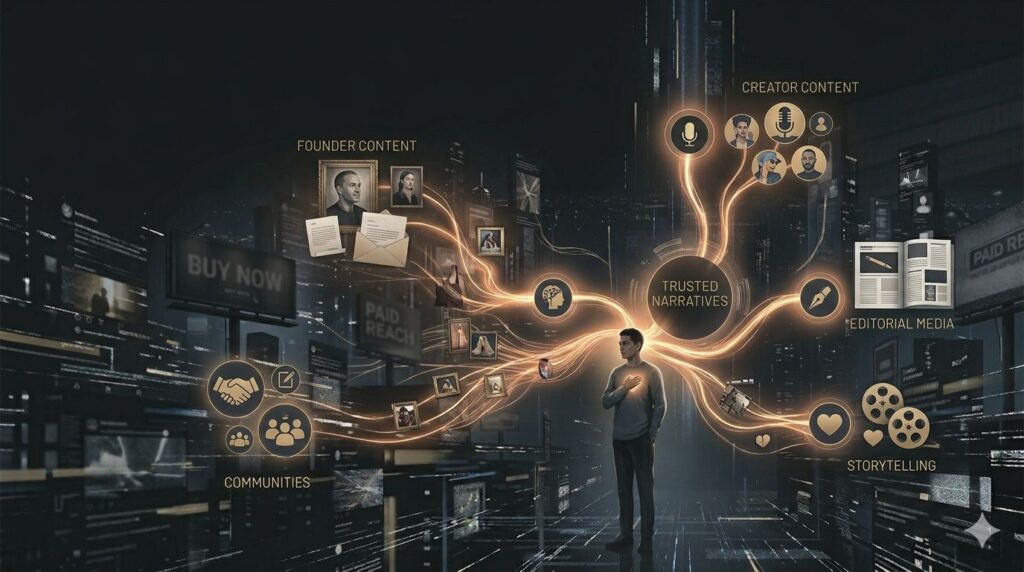
Winners will be companies that build cultural memorability, own direct audience relationships, shape industry narratives, and become recurring sources of attention independent of media spend. Over a decade, their unit economics diverge radically from companies competing primarily on reach. One faces rising costs per acquisition and declining lifetime value. The other faces declining costs as network effects compounds.
This doesn’t mean advertising disappears. It means the balance of power has shifted. Companies competing primarily on reach will face rising costs and declining returns. Companies competing on owned narrative those difficult to ignore through merit rather than spend will enjoy structural advantages that compound through the decade.
In an economy overwhelmed by infinite content, fragmenting attention spans, and algorithmic uncertainty, visibility alone is no longer defensible. The real strategic advantage increasingly belongs to those who become difficult to ignore.